
The Game That Became a World
The PeripheralThis thread traces how Flynne Fisher’s uncertain understanding of a paid security simulation turns into recognition that she is witnessing real events in a divergent world, and how that revelation unsettles the boundary between play and responsibility.
increasing Bearing strength in each event
 decreasing
Bearing strength in each eventdecreasingA Paid Simulation
A Paid Simulation
Work Without Context
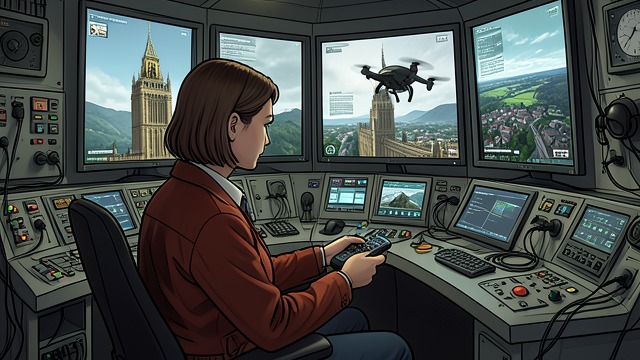
Flynne Fisher accepts Burton Fisher’s well-paid substitute shift as a job inside what he calls a beta game. Her task is to fly a quadcopter around a London tower and keep paparazzi drones away from its windows. The unfamiliar city, remote controls, and invisible dispatch-like voices make the work strange, but not yet unbelievable.
The assignment’s ordinary procedures give the experience a convincing frame: she patrols, reacts to moving objects, and is paid for a shift. That frame lets her treat what she sees as information generated by a game rather than as evidence about other people’s lives.
The Frame Begins to Fail
When a window clears and people appear inside, her curiosity grows beyond the perimeter she was hired to guard. The scene feels authored and watchable, like a show, but its private details resist the neatness of a conventional game. Her uncertainty is not a failure of perception; it is the first sign that the simulation’s label hides a more consequential reality.
An Unwitnessed Murder

An Unwitnessed Murder
A Threat in the Building
On her next shift, Flynne Fisher notices a gray, animal-like object climbing the tower. It changes shape to blend into the wet facade, then attacks her camera with tiny cutting machines. Its disguise and behavior look like game mechanics, but the danger is immediate enough to make her abandon routine patrol.
She sees the man at the window place a woman’s hands over her eyes and kiss her ear before withdrawing. The gray object opens, releases a swarm, and the woman is consumed from within. Flynne follows the falling remains, unable to intervene in time.
Watching Becomes Witnessing
The killing changes the ethical meaning of looking. What had been voyeuristic entertainment now leaves Flynne with a witness’s burden: she has seen an event that someone has staged and another person has suffered. Her private grief is the first clue that this world’s apparent unreality cannot insulate her from its consequences.
The Convenient Word
The Convenient Word
Naming the Experience
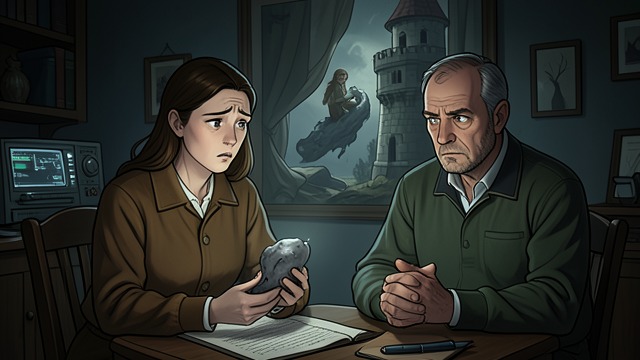
When Wilf Netherton asks what she witnessed, Flynne describes the climbing object, the attack, and the man who seemed to know what would happen. She still calls the setting a game because that is the explanation she has been given and the only familiar category available to her.
Wilf and the people around him have reasons to preserve that category. It keeps the arrangement manageable, protects their distance from the inhabitants of the other world, and avoids explaining how a connection to a past-like continuum can be real without being ordinary time travel.
The Cost of Evasion
The phrase game does not settle what the experience is; it postpones the moment when its participants must take responsibility for it. Flynne hears the evasion in Wilf’s answers and begins to distinguish being unable to explain something from pretending that it does not matter. The mismatch between her direct experience and his carefully qualified language becomes part of the story’s moral tension.
A Body Across the Divide
A Body Across the Divide
The Remote Body
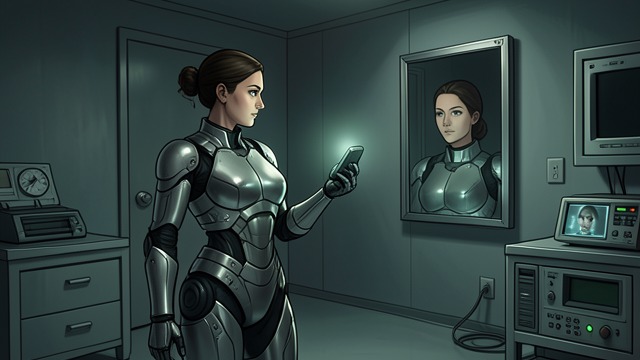
Macon and Edward’s improvised Neural cutout lets Flynne inhabit a manufactured body in Wilf Netherton’s London. She wakes in a place she cannot initially identify, sees a face that is not hers in a mirror, and learns that the body is an anthropomorphic drone rather than a game character.
The transfer makes her senses and movement feel bodily, even though her physical body remains back in Burton’s Airstream trailer. A phone-like interface, touch, balance, and smell establish an intimate presence that conventional screen-based play could not supply.
Presence Without Certainty
Flynne’s embodied experience does not answer every metaphysical question. She still asks whether the world could be a game, and the people hosting her cannot fully explain the server or the connection. Yet the inability to prove everything does not erase what she feels or the risks she has already encountered.
The peripheral therefore complicates the distinction between authentic and artificial experience. Flynne is not physically in London, but she is not merely watching it either; the novel asks whether moral presence depends on location, embodiment, or the consequences of action.
Reality Without a Guarantee

Reality Without a Guarantee
Consequences Across Worlds
At Daedra West’s gathering, Flynne recognizes the balcony man and helps expose his role in Aelita West’s death. She and Wilf are physically present through peripherals, while their bodies remain elsewhere; nevertheless, the encounter brings real injury, danger, and political consequences.
The attacker’s ability to move through walls with Assemblers makes the event seem even less bound by the physical rules Flynne knows. But the violence is not thereby unreal. Flynne’s recognition and choices determine what happens next, including the confrontation that prevents the threatened attack on her home world from proceeding as planned.
Responsibility Without Metaphysical Comfort
The story never offers Flynne a simple test that can certify every layer of reality. Instead, it makes responsibility legible through consequences: people can be harmed, power can be exercised, and choices can alter lives across the connection. The question is no longer whether the experience qualifies as a game, but whether that label excuses anyone from acting responsibly.
At the start of Flynne Fisher’s first security shift
During Flynne Fisher’s second security shift
After Flynne Fisher’s account reaches Wilf Netherton
At Flynne Fisher’s first arrival in the Gobiwagen
After Flynne Fisher and Wilf Netherton confront the attacker at Daedra West’s gathering
